
Published Date: 26th Oct, 2026
- A heavy equipment rental marketplace connects equipment owners and rental businesses with contractors and other customers through a centralized online platform.
- Essential features include vendor registration, equipment listings, availability calendars, booking management, online payments, commission tracking, delivery scheduling, and administrative reporting.
- Building the marketplace involves defining the business model, researching demand, onboarding reliable vendors, selecting suitable software, configuring features, and testing the rental journey before launch.
- Development costs depend on the software approach, customization, integrations, hosting, support, and operational requirements. Ready-made solutions such as Yo!Rent can provide a starting point for evaluating marketplace-specific capabilities.
The construction industry relies on heavy equipment such as excavators, bulldozers, cranes, forklifts, and loaders to complete projects efficiently. However, finding available machinery, comparing rental prices, and coordinating with multiple equipment providers can be challenging for construction companies and contractors.
An online marketplace for heavy equipment rental businesses simplifies this process by connecting equipment owners with customers through a centralized platform. It allows providers to showcase their machinery, manage bookings, and reach a wider customer base without relying solely on manual rental processes.
Building such a marketplace requires a well-defined business model, essential rental features, and the right equipment rental software. This guide explores how to build a heavy equipment rental marketplace, covering everything from business planning and software selection to platform launch and long-term growth.
Table of Contents
- What is a Heavy Equipment Rental Marketplace?
- Why Build an Online Heavy Equipment Rental Marketplace?
- Essential Features of Heavy Equipment Rental Marketplace Software
- Steps to Build a Marketplace for Heavy Equipment Rental Businesses
- How Much Does it Cost to Build a Heavy Equipment Rental Marketplace?
- Conclusion
- FAQ’s
What is a Heavy Equipment Rental Marketplace?
A heavy equipment rental marketplace is an online platform that connects equipment owners and rental businesses with customers seeking machinery for construction, infrastructure, and industrial projects. It allows multiple vendors to list equipment, while marketplace owners earn revenue through commissions, subscriptions, or featured listings without necessarily owning the machinery.
How Does a Heavy Equipment Rental Marketplace Work?
A heavy equipment rental marketplace typically operates through these steps:
- Vendor Registration: Rental businesses register and list machinery with specifications, rental rates, photos, and availability.
- Equipment Search: Customers browse listings and compare equipment, prices, rental terms, and availability.
- Booking and Payment: Customers select rental dates, submit bookings, and complete payments through the platform.
- Delivery and Pickup: Vendors or logistics partners coordinate equipment transportation.
- Equipment Return: Vendors inspect returned machinery and update its availability.
- Marketplace Management: The administrator oversees vendors, bookings, commissions, transactions, and customer disputes.
Turn Your Heavy Equipment Rental Idea Into Reality
Why Build an Online Heavy Equipment Rental Marketplace?
An online heavy equipment rental marketplace connects multiple equipment providers with customers through a centralized platform. It creates opportunities for rental businesses to expand their reach, contractors to find suitable machinery, and entrepreneurs to build a scalable business without owning the equipment themselves.
1. Expand Market Reach and Booking Opportunities
Rental businesses can showcase their machinery to a wider audience, improve online visibility, and attract more potential customers. Contractors can also compare equipment specifications, rental rates, availability, and delivery options in one place.
2. Build a Scalable Business Model
Entrepreneurs can partner with existing equipment rental providers instead of investing in their own machinery. Revenue can be generated through booking commissions, vendor subscriptions, featured listings, and additional services.
3. Simplify Equipment Discovery and Rentals
A centralized platform makes it easier for customers to find suitable machinery and coordinate rentals. Features such as equipment listings, availability calendars, and booking management can also streamline interactions between customers and vendors.
4. Create Opportunities for Business Growth
A well-managed marketplace can expand by onboarding more rental providers, adding equipment categories, and entering new markets. However, long-term success depends on maintaining accurate listings, building a reliable vendor network, and delivering a smooth rental experience.
Essential Features of Heavy Equipment Rental Marketplace Software
Choosing the right heavy equipment rental marketplace software is essential for managing multiple vendors, coordinating equipment rental, and delivering a seamless booking experience. The platform should support equipment discovery, inventory management, payments, and rental operations while giving administrators control over marketplace activities.
1. Vendor Registration and Equipment Listing Management
The platform should allow equipment rental businesses to create profiles, upload machinery listings, and manage their inventory. Each listing should include equipment specifications, rental rates, photos, location, operating requirements, and availability. Vendor verification can also help marketplace owners establish trust and reduce fraudulent listings.
2. Equipment Search and Availability Management
Customers should be able to find suitable machinery using filters such as equipment type, location, rental price, rental duration, and technical specifications. Advanced search capabilities help contractors identify equipment that meets their project requirements.
3. Equipment Availability and Inventory Management
Availability calendars and inventory tracking help vendors manage their machinery across rental periods. Real-time availability updates can reduce double bookings and prevent customers from reserving equipment that is already rented out.
4. Booking and Reservation Management
The software should support booking requests, confirmations, modifications, cancellations, and rental scheduling. Automated notifications can keep customers and vendors informed about booking status, upcoming rentals, and return dates.
5. Online Payments and Security Deposits
Integrated payment gateways allow customers to pay rental charges and security deposits online. The platform should also support refunds, invoices, and payment tracking to simplify transactions and improve financial transparency.
6. Commission Management and Vendor Payouts
Marketplace administrators should be able to configure commission rates, calculate vendor earnings, track transactions, and manage payouts. Transparent commission reporting helps maintain clear financial relationships between the platform and its rental partners.
7. Rental Agreements and Digital Documentation
Digital rental agreements can outline rental periods, payment terms, equipment usage conditions, and damage responsibilities. The platform should also support invoices and relevant rental documents to help vendors and customers maintain clear records.
8. Delivery and Pickup Scheduling
Heavy machinery often requires specialized transportation. Delivery scheduling tools should help vendors coordinate transportation, confirm delivery and pickup dates, and communicate logistics details with customers.
9. Equipment Inspection and Damage Reporting
Equipment inspection records help vendors document machinery conditions before and after rentals. Damage reports, photographs, and maintenance records can support dispute resolution and help vendors maintain equipment quality.
10. Customer and Vendor Communication
Built-in messaging, email notifications, and booking alerts help customers and vendors coordinate rental requirements. These tools can simplify discussions about equipment specifications, delivery arrangements, booking changes, and other rental-related queries.
11. Reviews and Ratings
A review and rating system allows customers to share feedback about equipment quality, vendor reliability, and rental experiences. This information helps future customers make informed decisions while encouraging vendors to maintain service standards.
12. Admin Dashboard and Reporting
A centralized dashboard should provide visibility into vendors, equipment listings, bookings, payments, commissions, and customer activity. Reporting and analytics can help administrators monitor marketplace performance, identify popular equipment categories, and make informed business decisions.
Elevate Your Heavy Equipment Rental Platform with a Strong Suite of Features
Steps to Build a Marketplace for Heavy Equipment Rental Businesses
Building a heavy equipment rental marketplace requires careful planning, market research, and the right technology. From defining your business model to onboarding equipment providers, each step helps establish a reliable platform that meets customer needs and supports long-term growth.
Listed below are the steps to build a marketplace for heavy equipment rental marketplace:
Step 1. Research the Market and Define Your Marketplace Business Model
Analyze the existing rental market, competitor platforms, customer requirements, and demand for different equipment categories. Identify gaps in equipment availability, pricing, and rental services that your marketplace can address.
Next, define your target audience, geographical reach, and revenue model. You can generate income through rental commissions, vendor subscriptions, featured listings, or service fees. These decisions will help determine your platform’s requirements and guide your launch strategy.
Step 2. Identify Equipment Rental Vendors
Identify and approach equipment rental businesses that can supply the machinery your target customers need. Prioritize vendors with a relevant equipment inventory, transparent rental terms, and reliable availability information.
Establish clear vendor onboarding criteria, equipment verification procedures, and expectations for maintaining accurate listings. Discuss rental pricing, delivery arrangements, and responsibilities for equipment maintenance and damage. Building a dependable vendor network before launch helps ensure customers have access to suitable equipment and reliable rental services.
Step 3. Choose the Right Development Approach
The cost of building a heavy equipment rental marketplace depends on the software model, customization requirements, integrations, and ongoing operational needs.
- Self-hosted marketplace software offers greater control over hosting, data, and customization. Costs typically include a software license, server infrastructure, initial setup, feature enhancements, security updates, and ongoing maintenance.
- SaaS marketplace software operates on a subscription-based model, with the provider managing hosting, infrastructure, and software maintenance. Costs generally include monthly or annual subscriptions, transaction fees where applicable, and additional charges for premium features, integrations, or customization.
Compare solutions based on rental-specific functionality, ease of use, payment integrations, scalability, technical support, and total cost of ownership.
The right solution should accommodate your current requirements while allowing you to expand equipment categories, onboard additional vendors, and serve more customers as the marketplace grows.
Consider Yo!Rent for Your Heavy Equipment Rental Marketplace
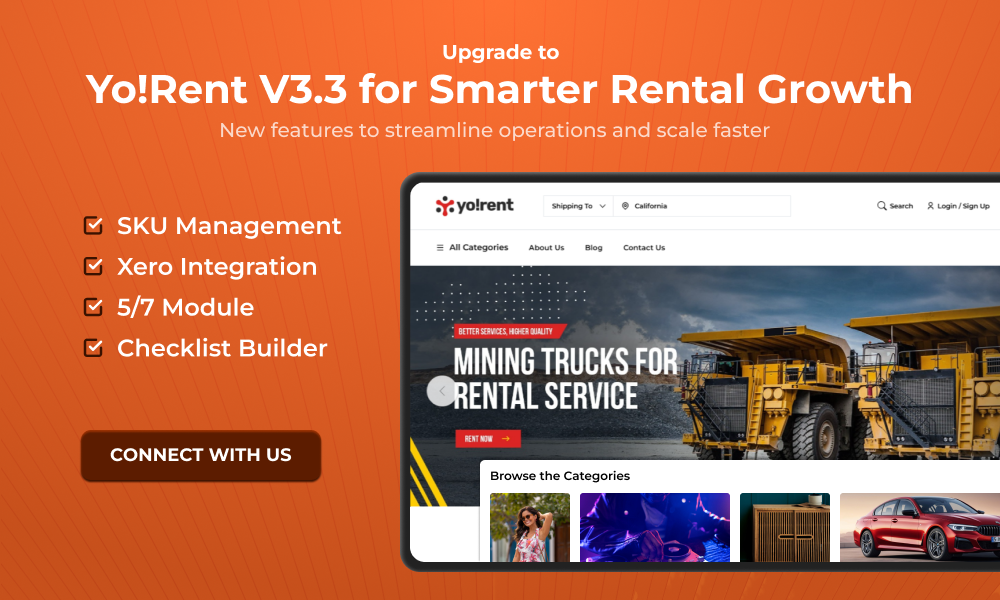
Yo!Rent by FATbit Technologies is a ready-made rental marketplace software solution that entrepreneurs can consider when planning a multi-vendor equipment rental platform. It provides a starting point for launching an online rental business without developing the entire platform from scratch.
Key capabilities to evaluate for your heavy equipment rental marketplace include:
- Vendor Management: Onboard multiple equipment rental businesses and manage their profiles and listings.
- Rental Booking Management: Facilitate rental reservations and manage booking workflows.
- Inventory Management: Track equipment availability and rental schedules to coordinate bookings.
- Payment Management: Support rental transactions and configure payment workflows according to your business requirements.
- Customization Options: Adapt marketplace functionality to accommodate heavy equipment rental requirements, including delivery coordination, security deposits, rental agreements, and equipment inspections, where supported or through customization.
Choosing a suitable solution can help simplify implementation and provide a foundation for expanding your vendor network and equipment categories as the marketplace grows.
Explore Rich Functionalities of Yo!Rent With Our Experts
Step 4. Finalize the Features
Finalize the marketplace features based on your business model, target audience, and operational requirements. Focus on the functionalities needed to manage equipment rentals efficiently and provide a seamless experience for customers and vendors.
Prioritize essential features such as:
- Vendor dashboards
- Equipment listings
- Search filters
- Availability calendars
- Booking management
- Online payments.
Additionally, define commission structures, cancellation policies, security deposits, and vendor payout procedures.
Consider operational requirements such as delivery coordination, digital rental agreements, equipment inspections, and customer support. Prioritize must-have features for the initial launch and plan to introduce advanced functionalities as your marketplace expands.
Step 5. Test and Launch Your Marketplace
Before launching publicly, test the complete rental process to ensure the platform functions as expected. Verify that vendors can create listings, customers can find available equipment, bookings are processed correctly, and payment and refund workflows function as expected.
Test cancellation rules, booking conflicts, notifications, mobile usability, and administrator controls. Confirm that rental terms, vendor responsibilities, delivery arrangements, and dispute procedures are clearly communicated.
Start with a limited group of equipment providers and customers to evaluate the platform under real-world conditions. Gather feedback, resolve operational issues, and improve the platform before expanding to additional vendors or geographic areas.
How Much Does it Cost to Build a Heavy Equipment Rental Marketplace?
The cost of building a heavy equipment rental marketplace depends on the software approach, feature requirements, customization, integrations, and ongoing operational needs.
- Ready-made marketplace software generally reduces the amount of custom development required because core capabilities are already available. Costs may include licensing, subscriptions, configuration, and additional integrations.
- Custom development typically requires a larger initial investment because the platform must be designed, developed, tested, and maintained around specific business requirements.
Beyond software costs, budget for payment processing, equipment provider onboarding, marketing, customer support, and operational management. Heavy equipment rental marketplaces may also require specialized logistics integrations, equipment verification, and rental availability management.
Launch Your Rental Marketplace Without Heavy Upfront Costs
Conclusion
Building a marketplace for heavy equipment rental businesses requires a clear business model, a dependable network of equipment providers, and software that supports multi-vendor rental operations.
By researching the market, selecting the right platform, configuring essential features, and testing the rental process before launch, you can establish a marketplace that connects equipment owners with customers more efficiently.
Focus on reliable listings, transparent rental terms, convenient bookings, and effective vendor management. With the right foundation and a gradual growth strategy, your marketplace can expand its equipment selection, attract more customers, and develop sustainable revenue streams.
FAQ‘s
How long does it take to build a heavy equipment rental marketplace?
The timeline to build a heavy equipment rental marketplace depends on the software approach, customization requirements, integrations, and operational complexity. A ready-made solution may be configured faster than a custom-built platform, which requires additional design, development, and testing.
Can I build a heavy equipment rental marketplace without owning equipment?
Yes, a multi-vendor marketplace can connect independent equipment owners and rental companies with customers without requiring the marketplace operator to own all the machinery. However, the operator must establish clear vendor agreements, rental policies, payment procedures, and responsibility for delivery, maintenance, and damage claims.
How does a heavy equipment rental marketplace make money?
A heavy equipment rental marketplace generates income via various channels. Common revenue models include:
- Commissions on completed rentals
- Vendor subscription plans
- Featured equipment listings
- Fees for optional services
The most suitable approach depends on the marketplace’s customer base, transaction values, and operating expenses.
What challenges should I consider before launching a heavy equipment rental marketplace?
Common challenges to consider before launching a heavy equipment rental marketplace include:
- Recruiting reliable vendors
- Maintaining accurate equipment availability
- Coordinating heavy equipment transportation
- Handling cancellations
- Managing payment disputes
- Establishing appropriate insurance and damage policies
Clear operating procedures and suitable software can help address these challenges.

Launch Your Heavy Equipment Rental Marketplace
Get Started